
What AI shortlisting software actually does for a small hiring team
How AI shortlisting helps small teams review applications, where it can miss relevant experience, and what to look for before you buy.
Published Nov 9, 2026•6-min read
AI shortlisting software compares applications with the requirements of a role and ranks or groups candidates for review. Some tools also summarize the experience behind a match. The useful result is a clearer starting point when you have more applications than time to read them.
We build these features at PontaHR. We also think they're worth judging quite practically: does the software help you understand your applicants faster, and can you check why it recommends someone?
Is it worth it if you only hire five people a year?
Five hires can still mean hundreds of applications. What matters is how much reviewing each role creates, and who has time to do it.
If you're a founder or the only HR person in a small company, that work often happens between other things. You read a few CVs, get interrupted, and come back later trying to remember which candidate had the experience you needed.
A useful shortlist gives that review some structure. Summaries help you get your bearings, while the ranking suggests which applications deserve an early look.
If you get six applications for each role, you may be perfectly happy reading them yourself. If you regularly receive sixty or two hundred, assistance with the first review becomes more valuable. The number of people you hire each year doesn't tell you much on its own.
Keyword matching and semantic matching: what's the difference?
A strict keyword search looks for specified terms. Semantic matching considers meaning and context, which can help connect a job requirement with experience described in different words.
But recognizing “Excel” and “MS Excel” isn't proof of sophisticated AI. Conventional search can handle equivalent terms through synonym rules. Systems can also combine keyword and semantic search, so this isn't a clean divide between two kinds of product.
A more revealing example is a customer support applicant whose CV says they handled returns, resolved delivery complaints, and trained shop staff. That could be relevant to an online retailer's support role, even if their previous title was “store supervisor.”
The question is whether the software identifies that connection and supports it with evidence. It shouldn't assume they have used your helpdesk software or managed an online support queue if the application doesn't say so.
| What you're checking | Useful behavior | A reason to look closer |
|---|---|---|
| Different wording | Connects relevant experience with the requirement | Depends on repeating the job description's phrases |
| Different job title | Considers the work the person describes | Relies heavily on the title alone |
| Missing information | Identifies something to clarify | Presents an assumption as a confirmed skill |
| A high ranking | Gives reasons you can check in the application | Offers a score without useful supporting detail |
These are things to test in a demo, not promises that follow automatically from the word “semantic.”
Where AI shortlisting falls short
A ranking reflects the information and criteria used to produce it. If your job description lists every desirable skill as essential, the results may favor someone who mentions all of them over someone with deeper experience in the work that matters most.
Start by separating genuine requirements from things a new hire could learn. Be specific about the work they'll do.
Even then, an application is an incomplete account of a person. A short CV may leave out relevant experience. A polished one may make modest responsibilities sound impressive. Software can misread either, and a convincing explanation still needs checking.
Bias also deserves attention. Ask how the vendor tests for unfair outcomes and which information affects the ranking. The ICO's guidance on AI in recruitment recommends assessing privacy risks and clarifying responsibilities before adopting a tool.
Keep the full applicant list accessible. Reviewing some lower-ranked applications can help you spot problems, although it doesn't establish that a system is fair or accurate. Someone on your team needs the time and authority to question its recommendations.
How to test it before you buy
Ask for a demonstration using a realistic job description and a small set of fictional candidate profiles. Include an obvious match, someone with transferable experience, and someone who uses the right terminology but offers little evidence of doing the work.
Then check:
- Why did each person rank where they did? Look for specific experience you can verify in the application.
- What did the software miss or assume? Pay particular attention to the candidate with a less conventional background.
- Can you correct the criteria? Ask what happens when you change a requirement, and whether existing applications are reassessed.
- Is reviewing the results easier? Time spent checking and correcting the output counts too.
This won't prove how the tool performs across every role. It will tell you more than a polished demo with three perfect candidates. Our candidate screening guide covers the wider review process.
Check the rules that apply to your hiring
In the EU, recruitment tools that analyse or evaluate candidates can fall within the AI Act's high-risk category. As of November 2026, the European Commission lists 2 December 2027 as the application date for the high-risk rules covering employment. Some obligations already apply, and existing data protection duties continue. Having a human make the final decision doesn't automatically remove a tool from scope.
In New York City, Local Law 144 applies to certain automated employment decision tools and uses. Where it applies, employers and employment agencies must ensure an independent bias audit was completed within the previous year, publish the required summary, and provide the required notices.
Ask the vendor what applies to its features and your intended use, what documentation it provides, and what your team needs to do. A general assurance of compliance won't answer those questions.
How this works in PontaHR
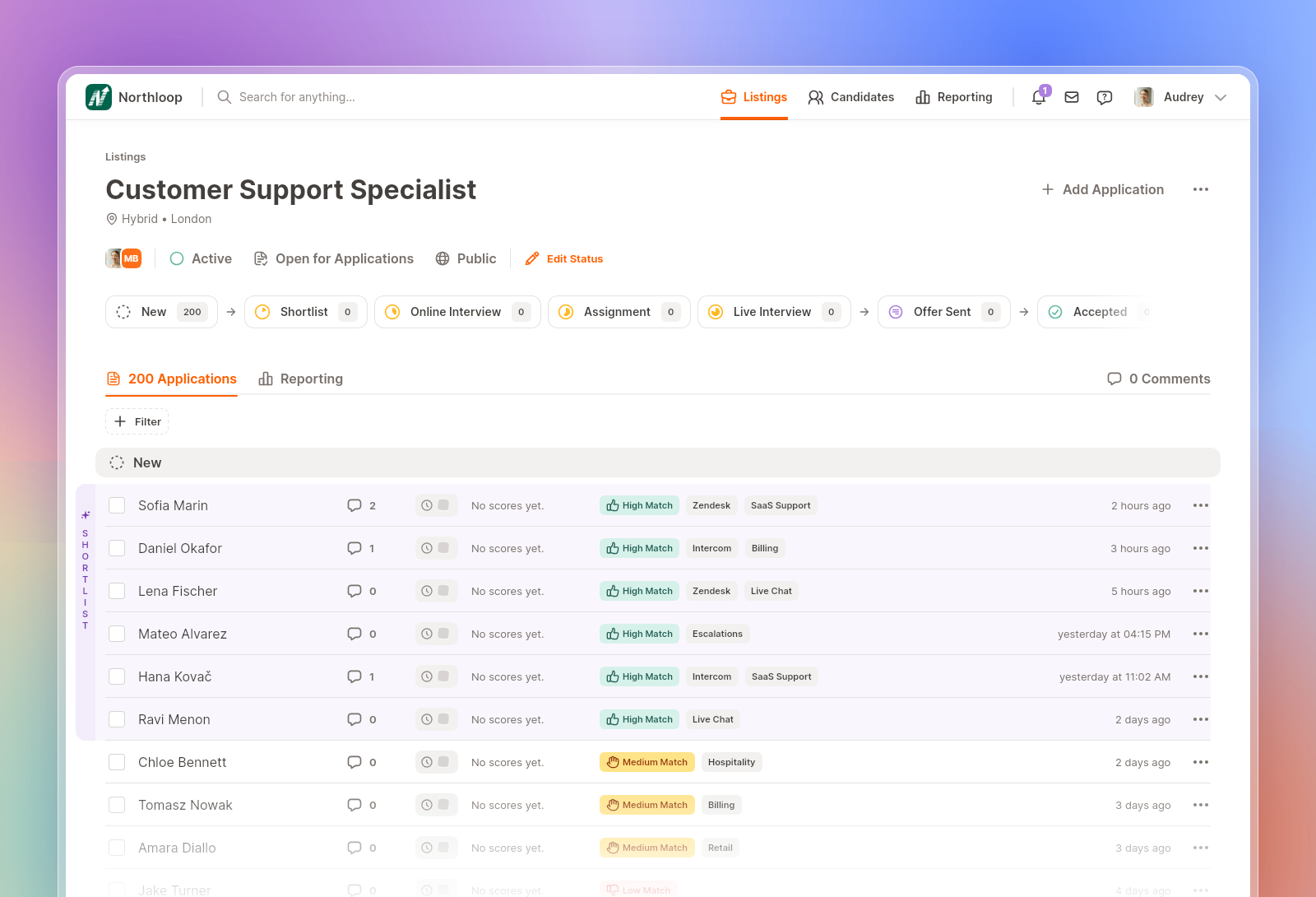
PontaHR's candidate intelligence ranks applicants against the role and provides summaries to help you review their experience. It works within the applicant tracking system, alongside the applications, conversations, and feedback your team uses to make decisions.
AI shortlisting and interview scheduling are included in Grow, at $210/month. Start is $89/month; both plans include unlimited users and job listings. Those are monthly USD prices as of November 2026, with annual options on our pricing page.
If you're comparing products, our guide to AI recruiting tools for small businesses covers more options. If you'd like to see PontaHR, bring a role you're hiring for to a demo. We'll walk through the shortlist and summaries so you can judge whether they'd help with your next round of applications.
Leave complicated hiring behind.
The all-in-one ATS that makes hiring faster, simpler, and genuinely enjoyable for your whole team.
Author

Ivan has spent over a decade building businesses and hiring teams. He brings a founder’s perspective on the recruitment challenges small and growing companies face.
Read more
↓

CareerPlug vs JazzHR: pricing, features, and fit for small teams
How CareerPlug and JazzHR compare on cost, features, and everyday hiring—and when PontaHR might be a better fit for your team.
Nov 9, 2026•7-min read

Choosing a GDPR-compliant ATS: a checklist for EU and UK teams
What to ask your ATS vendor about candidate data, privacy, and AI—and what to check for yourself before you commit.
Nov 9, 2026•8-min read

Leaving Breezy HR? How to Switch Without Starting Over
What to compare before choosing a new ATS, how to bring your hiring history with you, and how PontaHR can help with the move.
Oct 30, 2026•8-min read